


This is La Gente’s Fall 2011 Issue. The theme was Opportunity.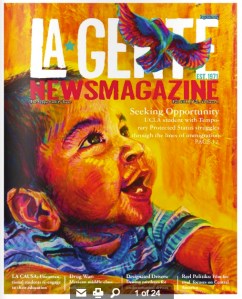
This is La Gente’s Winter 2012 Issue. The theme for this issue was profiles. 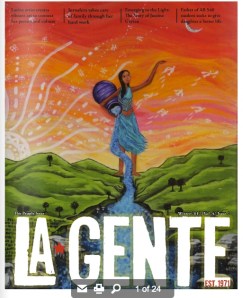
This is La Gente’s Spring 2012 Issue. The theme was the Latino Vote.
Originally published on BrooklynCampaign.com on September 19, 2012.
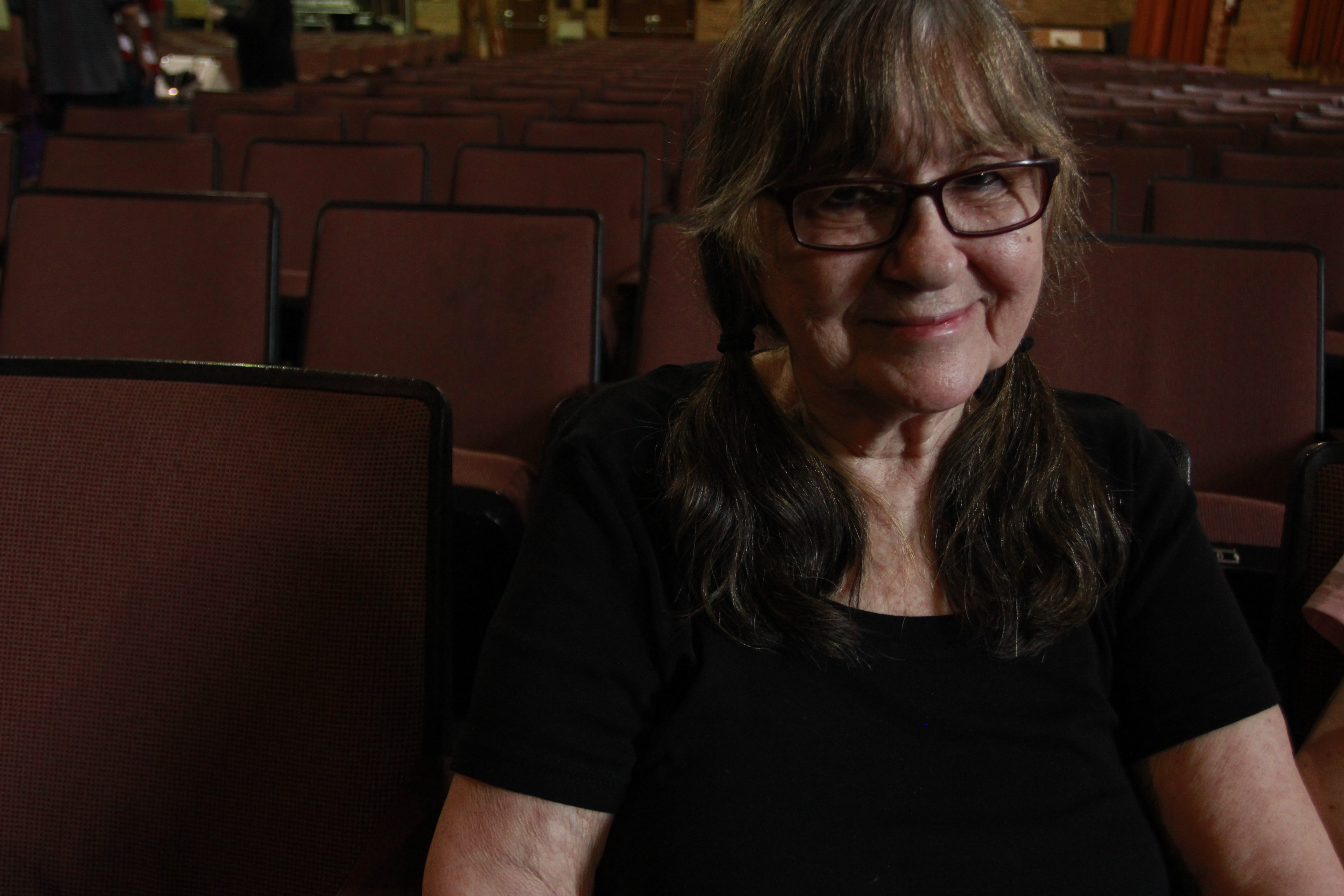
BROOKLYN, NY—Emily Peters had a bad case of nerves. After spending decades as an amateur songwriter, the 79-year-old was singing one of her tunes in front of friends and neighbors for the first time.
She chose “Ice Cream Parlor Song,” which recounts the Crown Heights neighborhood of her youth.
“A time long ago no more. When there was still an ice cream parlor there,” she sang.
The scene was at Xaverian High School, where auditions for Bay Ridge’s 6th Annual Senior Idol, were held September 8th. The talent contest, modeled on television’s “American Idol,” is hosted by Sen. Martin Golden for participants over age 50.<br>
At the audition, participants had 1 minute to introduce themselves and 2 minutes to sing –even if they were cut off before the grand finale.
Songs ranged from Fiddler on the Roof’s “If I were a Rich Man,” Frank Sinatra’s “My Way,” My Fair Lady’s “I Could’ve Danced All Night,” and even an Italian aria.
Instead of one of these classics, Peters picked a tune from her personal songbook.
“[It was] now or never. After a while, I’ll just do it. See what happens,” she said.
“It is things like this bring that communities close and [help] keep their identity,” said Vinny Iannelli, 27, the music director at Xaverian High School and of Senior Idol.
Iannelli should know: His parents, grandparents, and great-grandparents are all Brooklynites with origins from Italy.
Peters also has European roots. Her father immigrated from Greece to Brooklyn in 1920s, soon after which he began working at the Grand Square Confectionary, located in Crown Heights on Bedford Avenue near Ebbets Field (the former home of the Dodgers, which was demolished in 1960).
As a young girl, Peters spent time at the movie house next to her father’s ice cream parlor, where a janitor would let her go on stage and “sing like a star.” Today, the parlor is boarded up.
“Everyone remembers the same thing: places, ice cream,” she said.
She described playing around with a Yamaha keyboard for her compositions. As for her songs, she said that the words simply come to her. “I wonder how it even happens,” she said.
Peters wrote poetry but never did music professionally. After graduating from Prospect Heights High School, she obtained a scholarship to go to college but never attended and worked as a medical secretary. Peters’ husband died young, after which she didn’t remarry.
During the audition, there was the occasional snore since two men had fallen asleep in the audience.
“Soon only memories remain. Couldn’t I go home again?” sang Peters as her two-minutes in the spotlight ended.
Brooklyn’s 6th Annual Senior Idol will take place on October 13th at 7pm.
The owner of La Casa Azul, Aurora Anaya-Cerda, talks about her journey to creating the bookstore and its significance to the community of East Harlem.

Originally published in La Gente Newsmagazine for its Winter 2011 Issue.
The film “From Prada to Nada” is a rehashing of Jane Austen’s “Sense and Sensibility.” When their Mexican father dies, sisters Nora and Mary are forced out of their Beverly Hills mansion and in with their aunt in East Los Angeles.
The marketing of the film focused on the materialism of the two girls, especially because they are forced to move to a low-income neighborhood. I feared another attempt at repackaging Latino culture in a superficial film for the masses. Surprisingly, it sweetly and comically portrays two young women learning to embrace their roots and family.
Despite having Latino servants who cook traditional Mexican food and a Mexican father with a big bigote who has mariachi for his birthday, Latino culture hasn’t actually been a part of Nora and Mary’s lives. Moving to East LA with their aunt and being befriended by a tattooed neighbor may be the archetype of Latino neighborhoods, but the portrayal of this neighborhood moves beyond the cholos and helicopters they first encounter. It becomes a hub of Mexican heritage, Spanish language, artwork, and community.
Nora transitions easily to her new home, learning Spanish, and dressing in colorful indigenous clothing. She uses her lawyer skills to take on a pro bono case defending Latino maintenance workers who were unjustly fired and eventually setting up an office to give free legal advice.
Mary takes longer to adjust, at first only identifying herself as Mexican to protect herself from cholas who call her a white girl and to impress her Mexican TA from school. In the end, she comes to accept her identity as something that is a part of her, not as something to portray.
Growing up, Nora and Mary experienced fragments of Mexican culture because of their father, but they did not have a community in which they could see all the pieces fit together and appreciate it until they moved in with their aunt.
One delightful aspect of the film is the featured street art. There is scene in which Bruno, the tattooed neighbor, teaches kids about the art and its significance (even referring to Judy Baca, a muralist and a professor at UCLA), creating the image of a flourishing community that also has beauty.
Another great perspective presented by the film is the diversity within the Latino community: their entrepreneur father, gardeners and servants in the mansion, the undocumented workers in East Los Angeles, the cholo in the low-income neighborhood, Latinos in the university, and the Latino artists. The range of Latino cast members is greater than a similarly mass-marketed film “Beverly Hills Chihuahua”, in which they only seem to exist as gardeners or in Mexico.
The last scene includes a mural with the words “Soy Americano? Soy Mexicano? Que Soy?” These are questions many Latinos—not just of Mexican background—are likely ask themselves as they experience Latino culture in an American society. This film may have felt superficial to some, but at least I cannot deny the depth it presented with those last words. Three out of four stars.
Originally published in La Gente Newsmagazine in the Fall 2009 issue.
To me, Aztlán means to “remember your roots;” it means to appreciate the lives of your parents and their parents, so that you can understand and appreciate what is a part of you. Aztlán is a call to remember the past.
As a child, every now and then I would realize that my family only spoke Spanish to me because they were from a different country, and that my teachers didn’t understand that language. As a college student, I realized that my life had some of the “typical” experiences that Hispanics face when they immigrate to the United States.
My mother was a housekeeper. As a young girl, this simply meant that she had a job, a place to go after she dropped me off from school. For me, there was no social significance behind it. However, it represented something bigger than just my life.
Being a housekeeper is a common way for an immigrant mother to make a living. I began to realize that there were other women who spoke Spanish that went to big houses and took care of other children, while they left their own children at home or at a daycare.
A barrier began to appear between everyone else and the people who shared my heritage, and this barrier gradually began to sharpen as I continued to observe my surroundings. Statistics about academic success, family values, place of origin, and education all became a part of this barrier.
People told me that I had to have a college dream because that is what my parents suffered for. What were my big dreams that would repay their sacrifice? Did my parents suffer? All they told was that I had to do well in school and to find something that would make happy.
I never really interpreted my life as being the “typical Latino experience.” Those questions of “what am I” only occurred in the context of the existential question of “who am I” I was satisfied with being la hija de mis padres.
Now in college, there is a push to have that appreciation for all those little things that make me Latina/Chicana/Hispanic/Mexican/Guatemalan in America. To some people I wasn’t Latina at all; I was a whitewashed first-generation young woman who didn’t appreciate her past.
These terms that are supposed to define and categorize me frustrate me. If these words only apply to those whose parents worked more than one job and live in a predominant Latino neighborhood with many obstacles to academic success, am I allowed to classify myself? I have come to ask myself this question as I surround myself with people who are passionate about these identities.
Originally published for La Gente Newsmagazine.
Improving Dreams, Equality, Access and Success (IDEAS) presented a workshop in January explaining the effects of the University of California’s 32% fee hike on undocumented students.
High school students and other campus organizations as well as students from the San Fernando Valley attended, uniting in an effort to help undocumented students pay tuition, attend college, and graduate with the possibility of continuing their education. In the United States, there are 65,000 undocumented students who graduate from high school every year, including the 25,000 who graduate in California.
However, only 5 to 10 percent reach higher education and even fewer graduate. Because many of undocumented students face poverty, these fee increases may continue to lower their graduation rate. Undocumented students are penned as out-of-state students, thus they have to pay a higher tuition. Fortunately, the AB 540 law in California allows students who have lived here since their youth or who have attended a California high school for at least three years to pay in-state tuition.
Testimonials by undocumented students highlighted the financial difficulties they have had to overcome to attend UCLA, and unfortunately, these do not end once accepted to the university. To pay for tuition, everyday necessities are constant challenges for these students.
One student said, “You won’t eat so you can buy a book,” while another comments that these sacrifices are “what it takes to get that money.” Hardships become heavier when fees are raised for the UC system, forcing these students to attend college part-time, and perhaps eventually dropping out altogether.
A third student describes how these difficulties affect a parent’s mentality; though at first “the person who pushed me [was the one who] saw the obstacles,” it is more and more apparent that the financial burden may be too much.
In order to address this issue of access, IDEAS is pushing for institutional aid to be made available to undocumented students. Students pay fees that comprise institutional aid, but because they are undocumented, they are shut out from receiving it. IDEAS is also fundraising to pay fee for undocumented students. You can contribute by visiting their website at ideasla.org.
 Helga L. Salinas